Surface Protection
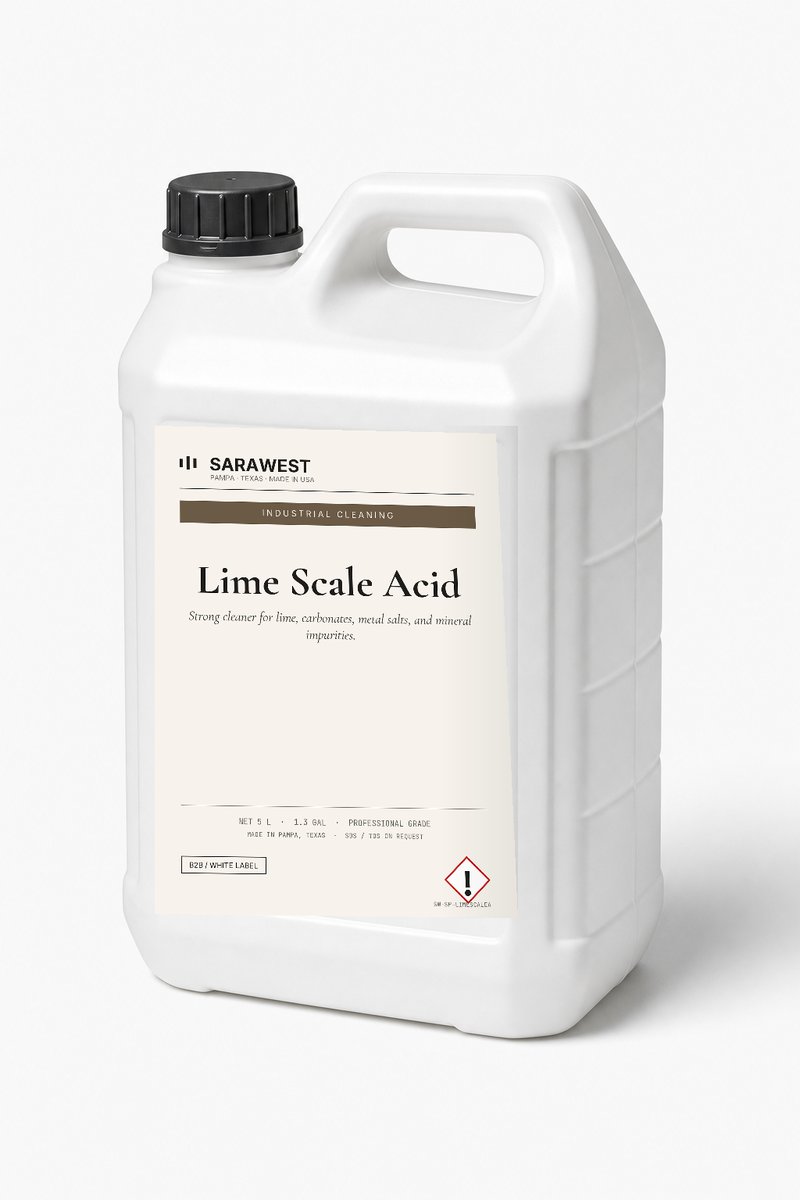
SaraWest Lime Scale Acid removes lime scale, carbonates, metal salts, rust impurities, and mineral deposits from compatible hard surfaces and bath cleaned objects.
B2B Verified
Factory Direct
Heritage 40+
Develop this formulation
A SaraWest base formula for your brand. Evaluation samples are prepared after scope approval and payment.
Development fees cover formulation work, lab time, and evaluation sample preparation. They are charged per agreed project and are required before work begins. Scope, sample quantity, revisions, minimum order quantity (MOQ), and timing are confirmed in your written agreement.
Request development →Submit for review. No payment is taken at this step.
Made in Pampa, Texas
Our chemists are downstairs. Your product is made right here.
Typical use cases
- 01Car wash tunnel manifolds and arches
- 02Heat exchangers and plate packs
- 03Stainless fixtures, tile, and porcelain
Drop scale fast with an inhibited acid that spares your base metal.
Scale wins when crews are stuck scraping fixtures, heat exchangers, and tunnel manifolds while production waits. Hard water bakes on carbonates and iron, throttling flow, wasting fuel, and staining stainless. Raw muriatic strips fast, but fumes, flash-rust, and soft-metal attack create new problems. You need repeatable descaling without pitting, etching, or extra downtime.
SaraWest Lime Scale Acid is a blended, inhibited acid system built to dissolve calcium carbonate, metal oxides, rust impurities, and mineral deposits on compatible hard surfaces and bath-cleaned parts. It wets, penetrates, and lifts scale in soak tanks or recirculating loops with low foam and fast rinse-off. The inhibitor package defends ferrous alloys while the acid does the work, cutting soak times versus mechanical methods and reducing rework.
Formulated and filled in our 30,000 sq ft plant in Pampa, Texas, this is contract-grade chemistry from a team with ~40 years’ formulation depth. Ship under your brand with turnkey private label - labels, color cues, and pack formats dialed to your channel. Standard fills: 33.8 oz, 1.3 gal, and 5 gal, with drums and totes available for programs that need bulk.
- Inhibited acid blend attacks scale without excessive base-metal loss or flash rust.
- Low-foam, fast-rinse system suited for soak tanks and recirculation loops.
- Effective on calcium carbonate, metal oxides, and iron staining in one pass.
- Reduced fuming versus raw muriatic improves indoor handling and operator comfort.
- Built for private label: consistent spec, repeatable color, and pack flexibility.
Personal protection: wear chemical-resistant gloves, eye/face protection, and apron. Provide ventilation. Always add acid to water, never the reverse.
Dilution (by volume): Heavy scale 1:1-1:4 with water. Moderate 1:4-1:8. Light maintenance 1:10-1:20. Use plastic or acid-resistant equipment. For recirculation, maintain solution temperature at 70-100°F; higher temperatures increase reaction rate but avoid exceeding 120°F.
Application: Pre-rinse loose soils. Apply by low-pressure spray, brush, soak, or circulate through the system. Ensure full wetting. Allow 5-30 minutes dwell depending on thickness and temperature. Do not let the solution dry on the surface. Agitation or flow across surfaces accelerates removal.
Rinse: When active bubbling subsides or target time is reached, drain and thoroughly rinse with clean water until runoff is clear. For ferrous alloys, follow with a mild alkaline rinse to neutralize residual acidity. Repeat if heavy deposits remain.
Compatibility: Safe on stainless steel, most ceramics, and many plastics. Do not use on aluminum, zinc, magnesium, natural stone (marble, limestone, travertine), or unsealed concrete/grout. Test inconspicuous area first.
- Typical soak clears tap-water scale in 10-30 minutes at 70-90°F.
- Removes up to 1/16 in mineral buildup in a single cycle with agitation.
- Heat exchanger approach temperature decreases by approximately 5-15°F after cleaning.
- Bath pH typically rises from ~1.5 to ≥5 as carbonate load is neutralized.
- Final rinse reaches near-neutral pH within 2-5 minutes of thorough flushing.
Factory-direct beats distributor layers. You get a purpose-built, inhibited acid with real reserves and rinseability, not a rebadged commodity. We formulate, blend, and fill in Pampa, Texas, so specs stay tight and lead times stay short. Private label options are turnkey - labels, color, packs - without paying for someone else’s markup. If you’re tired of fumes, flash rust, and inconsistent lots, step up to a controlled formulation from the source.